
Interpreting Control Charts: Western Electric Rules and Patterns
A free online reference for statistical process control, process capability analysis, measurement systems analysis,
control chart interpretation, and other quality metrics.
SPC DEMO
Minimize Production Costs, Quickly Detect Issues, and Optimize Your Product Quality
Don’t miss out! Book a demo of our specialized SPC software and unlock immediate improvements in your processes.
- Quality Advisor
- Data Collection Tools
- Data Analysis Tools
- Formulas and Tables
- Glossary
- Additional Resources
2 of 3 beyond 2 sigma
Note: Use this test for control sparingly. There is a tendency to overcontrol the system when using this test. Use it only when there is some doubt about the system’s stability.
The control limits drawn on control charts are located three standard deviations away from the average (or center line) of the chart. These are called “3-sigma” control limits. Sigma is the name of the symbol for standard deviation. The distance from the center line to the control limits can be divided into three equal parts, one sigma each, as shown below. If two out of three consecutive points on the same side of the average lie beyond the 2-sigma limits, the system is said to be unstable. The chart below demonstrates this rule.
See also:
>> Any nonrandom pattern
>> Too close to the average
>> Too far from the average
>> Cycles
>> Trends
>> Sawtooth
>> Clusters
>> 4 of 5 points beyond 1 sigma
Additional reference material
Additional sections from legacy interpretation:
Interpretation
Additional sections from legacy any-point-lying-outside-the-control-limits:
Any point lying outside the control limits
This is the quickest and easiest test for system stability. Look above the upper control limit and below the lower control limit to see whether any points fall in those regions of the chart. If you are looking at a chart pair (X-bar and R, X-bar and s, or X and MR), look at both charts.
Points falling outside the control limits may be the result of a special cause that was corrected quickly, either intentionally or unintentionally. It may also point to an intermittent problem. The chart below shows two points outside the control limits.
See also:
>> Analyze for special causes of variation
>> Any point lying outside the control limits
>> 7 or more points in a row above or below the center line
>> 7 or more points in one direction
>> Any nonrandom pattern
Additional sections from legacy 4-of-5-beyond-1-sigma:
4 of 5 beyond 1 sigma
Note: Use this test for control sparingly. There is a tendency to overcontrol the system when using this test. Use it only when there is some doubt about the system’s stability.
When four out of five consecutive points lie beyond the 1-sigma limit on one side of the average, the system is declared unstable.
See also:
>> Any nonrandom pattern
>> Too close to the average
>> Too far from the average
>> Cycles
>> Trends
>> Sawtooth
>> Clusters
>> 2 of 3 points beyond 2 sigma
Additional sections from legacy 7-in-1-direction:
7 points in one direction, up or down
For this test, look for groups of points moving up or down in succession. Count consecutive points, including horizontal runs within the run. This pattern is probably the result of a trend in one of the system resources. The chart below shows a group of seven points moving downward.
See also:
>> Analyze for special causes of variation
>> Any point lying outside the control limits
>> 7 or more points in a row above or below the centerline
>> Any nonrandom pattern
Additional sections from legacy 7-in-row-above-below:
7 points in a row above or below the centerline
To apply this test, look for groups of points above or below the average or centerline. Count consecutive points. Are there groups of seven or more? This is probably the result of a shift in one of the system resources (materials, people, methods, environment, information aids, equipment, and measurement). The following chart, which can be created using SQCpack, shows two groups, one with eight above the centerline and one with seven below.
See also:
>> Analyze for special causes of variation
>> Any point lying outside the control limits
>> 7 or more points in one direction
>> Any nonrandom pattern
Additional sections from legacy analyze-for-special-cause-variation:
Analyze for special cause variation
The key to chart interpretation is to initially ascertain the type of variation in the system—that is, whether the variation is coming from special or common causes. When the system has only common causes of variation, it is referred to as stable or in control. If, however, the system has special causes of variation, it is referred to as unstable, or out of control.
Look any of the conditions listed below, which indicate that the process is statistically unstable:
When you have determined whether or not there is special cause variation, declare the system stable or unstable.
Additional sections from legacy chart-pairs:
What the chart pairs mean
Variables control chart pairs, which can be creating using SQCpack, illustrate central location and variability.
Analyzing for variability
To look for process variability, study the range, standard deviation (sigma), or moving range chart of the control chart pair. These will show how data points within the subgroup differ from each other. Interpret for variability first. If out-of-control conditions exist here, address them before continuing. Too much variability in the subgroups can be a difficult challenge, but until this variability is reduced, it does little good to work on the target or central location.
To understand this, consider a marksman. If the pattern of shot varies wildly, one time tight and another time loose, all the marksman can do is aim at the middle of the target and hope for the best (see Figure A). If he can tighten up the shot pattern, though, he can place shots to his choosing inside the target (see Figure B).
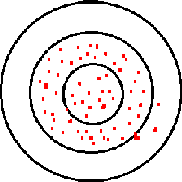
Figure A
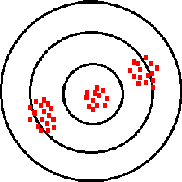
Figure B
Analyzing for central location
Use the average (X-bar), median, or individuals (X) chart to analyze the central location of the process. This indicates where the middle of the subgroup is.
Here the marksman’s shot pattern is tight, showing little variability, but where is it placed in relation to the bullseye? Figure C shows the variability is tight or precise, but there is no accuracy. Figure D shows a marksman whose shots are both precise and on target or accurate.
If you are considering an individuals and moving range chart, keep in mind that you are looking at actual readings from the system, not averages or medians. Individual readings may not be normally distributed for a stable system. They may be skewed if the system is naturally bounded on one side. Characteristics such as flatness and timeliness are bounded by zero.
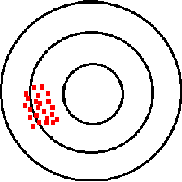
Figure C
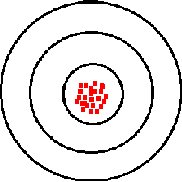
Figure D
Analyzing for variability
To look for process variability, study the range, standard deviation (sigma), or moving range chart of the control chart pair. These will show how data points within the subgroup differ from each other. Interpret for variability first. If out-of-control conditions exist here, address them before continuing. Too much variability in the subgroups can be a difficult challenge, but until this variability is reduced, it does little good to work on the target or central location.
To understand this, consider a marksman. If the pattern of shot varies wildly, one time tight and another time loose, all the marksman can do is aim at the middle of the target and hope for the best (see Figure A). If he can tighten up the shot pattern, though, he can place shots to his choosing inside the target (see Figure B).
Figure A
Figure B
Analyzing for central location
Use the average (X-bar), median, or individuals (X) chart to analyze the central location of the process. This indicates where the middle of the subgroup is.
Here the marksman’s shot pattern is tight, showing little variability, but where is it placed in relation to the bullseye? Figure C shows the variability is tight or precise, but there is no accuracy. Figure D shows a marksman whose shots are both precise and on target or accurate.
If you are considering an individuals and moving range chart, keep in mind that you are looking at actual readings from the system, not averages or medians. Individual readings may not be normally distributed for a stable system. They may be skewed if the system is naturally bounded on one side. Characteristics such as flatness and timeliness are bounded by zero.
Figure C
Figure D
Additional sections from legacy clusters:
Clusters
Note: Use this test for control sparingly. There is a tendency to overcontrol the system when using this test. Use it only when there is some doubt about the system’s stability.
When clustering is occurring, data appears in groups, even though there is no group of seven points in a row above or below the average. This pattern suggests that the system is “jumping” from one setting to another.
When trying to improve this process, questions should be asked about the transition periods between the clusters. What is causing the system to “jump”?
See also:
>> Any nonrandom pattern
>> Too close to the average
>> Too far from the average
>> Cycles
>> Trends
>> Sawtooth
>> 2 of 3 points beyond 2 sigma
>> 4 of 5 points beyond 1 sigma
Additional sections from legacy cycles:
Cycles
When cycles are occurring, the data rises and falls in a rhythmic pattern. The pattern is definitely not random. This could be caused by some regular, periodic change in the system.
A positive aspect of cycles is that they tend to indicate that there is one major cause of variation, which will typically be changing in a similar cyclic fashion. If the cause of the cycle can be established and reduced, this should result in a major improvement to the process.
See also:
>> Any nonrandom pattern
>> Too close to the average
>> Too far from the average
>> Trends
>> Clusters
>> Sawtooth
>> 2 of 3 points beyond 2 sigma
>> 4 of 5 points beyond 1 sigma
Additional sections from legacy declare-stable-or-unstable:
Declare the system stable or unstable
Unstable systems
If the system fails any of the tests for control, it is out-of-control or unstable.
If your system is unstable, does the special cause of variation create a favorable output? Does it improve the process? If yes, find the special cause(s) of variation. Try to replicate it and incorporate it into the process.
If not, and it creates a negative output or hurts the process, find the special cause(s) of variation and take steps to eliminate it. After you remove special causes of variation, continue collecting, charting, and analyzing the data. Once the process has been stabilized, consider performing capability analysis to compare how the process is running in relation to its specifications.
Stable systems
If it does not fail any of the tests for control, the process is stable.
If your process is stable, is the data normal distributed? Is it capable of producing output that is within specifications? You may want to create a histogram and perform capability analysis to learn more about your process.
If the process is stable, but failing to meet specification requirements, look for the source(s) of common cause variation. Can these be eliminated or reduced? How can the system be improved?
Note: A process that is currently stable, may not remain stable indefinitely. A new batch of raw material, a new operator, or new equipment, can change the output. Therefore, you should continue collecting, charting, and analyzing data for stable processes.
Capability analysis can be done using software products such as SQCpack.
See also:
>> Analyze for special cause variation
>> When do you recalculate control limits
>> What do the chart pairs mean (variables control charts only)
Unstable systems
If the system fails any of the tests for control, it is out-of-control or unstable.
If your system is unstable, does the special cause of variation create a favorable output? Does it improve the process? If yes, find the special cause(s) of variation. Try to replicate it and incorporate it into the process.
If not, and it creates a negative output or hurts the process, find the special cause(s) of variation and take steps to eliminate it. After you remove special causes of variation, continue collecting, charting, and analyzing the data. Once the process has been stabilized, consider performing capability analysis to compare how the process is running in relation to its specifications.
Stable systems
If it does not fail any of the tests for control, the process is stable.
If your process is stable, is the data normal distributed? Is it capable of producing output that is within specifications? You may want to create a histogram and perform capability analysis to learn more about your process.
If the process is stable, but failing to meet specification requirements, look for the source(s) of common cause variation. Can these be eliminated or reduced? How can the system be improved?
Note: A process that is currently stable, may not remain stable indefinitely. A new batch of raw material, a new operator, or new equipment, can change the output. Therefore, you should continue collecting, charting, and analyzing data for stable processes.
Capability analysis can be done using software products such as SQCpack.
See also:
>> Analyze for special cause variation
>> When do you recalculate control limits
>> What do the chart pairs mean (variables control charts only)
Additional sections from legacy nonrandom:
Any nonrandom pattern
This is the most complex test for stability. If the system is in control, one could imagine tilting the chart on one end and letting all the points slip down to form a normal curve. Roughly half the points would fall above and half below the centerline. Dividing the distance between the centerline and the control limits into three equal divisions up and three down, one could expect to find about two thirds of the total points in the middle two regions, and no repeatable patterns in the data.
Patterns in data are not random, and are, therefore, cause for investigation. To apply these tests, look for patterns in the plot. The following are examples of typical patterns:
>> Too close to the average
>> Too far from the average
>> Cycles
>> Trends
>> Clusters
>> Sawtooth
>> 2 of 3 points beyond 2 sigma
>> 4 of 5 points beyond 1 sigma
Additional sections from legacy recalculate-limits:
When do I recalculate control limits?
There is the tendency to recalculate control limits whenever a change is made to the process. However, you should extend the existing control limits out over the new data until you see evidence that the change has had an impact on the data, such as shifting or out-of-control evidence. Then recalculate limits using only data subgroups collected after the change was made.
There are no hard and fast rules for recalculating control limits, but here are some thoughts to help you decide.
The purpose of any control chart is to help you understand your process well enough to take the right action. This degree of understanding is possible only when the control limits appropriately reflect the expected behavior of the process. When the control limits no longer represent the expected behavior, you have lost your ability to take the right action. Merely recalculating the control limits is no guarantee that the new limits will properly reflect the expected behavior of the process.
- Have you seen the process change significantly, i.e., is there an assignable cause present?
- Do you understand the cause for the change in the process?
- Do you have reason to believe that the cause will remain in the process?
- Have you observed the changed process long enough to determine if newly-calculated limits will appropriately reflect the behavior of the process?
Ideally, you should be able to answer yes to all of these questions before recalculating control limits.
To create control charts and easily recalculate control limits, try software products like SQCpack.
See also:
>> Analyze for special cause variation
>> Declare the system stable or unstable
>> What do the chart pairs mean (variables control charts only)
Additional sections from legacy sawtooth:
Sawtooth
Note: Use this test for control sparingly. There is a tendency to overcontrol the system when using this test. Use it only when there is some doubt about the system’s stability.
The chart below shows a typical sawtooth pattern. Observe how the data points alternate above and below the center line. For some reason, alternate subgroups have greater and smaller averages. Stratifying or splitting the data by key variables may assist in analyzing this problem. This may occur if you alternate samples from two machines or production lines.
See also:
>> Any nonrandom pattern
>> Too close to the average
>> Too far from the average
>> Cycles
>> Trends
>> Clusters
>> 2 of 3 points beyond 2 sigma
>> 4 of 5 points beyond 1 sigma
Additional sections from legacy too-close:
Too close to the average
Notice that nearly all the points lie close to the average. This pattern could be caused by a number of circumstances, including:
- Edited data
- Reduced variability without recalculation of control limits
When this pattern occurs, try to establish why. Is this apparent improvement genuine? Can the improvement be maintained? If the improvement can be maintained, then the control limits need to be recalculated. Although the data looks more stable than normal, this condition is referred to statistically as “unstable”.
See also:
>> Any nonrandom pattern
>> Too far from the average
>> Cycles
>> Trends
>> Clusters
>> Sawtooth
>> 2 of 3 points beyond 2 sigma
>> 4 of 5 points beyond 1 sigma
Additional sections from legacy too-far:
Too far from the average
Notice how most of the points in the chart shown below are close to one control limit or the other. This pattern may indicate that subgroups have been drawn from two sources and the data has been mixed—for example, from two machines, two processes, or from two shifts. If this is the case, stratify (separate) the data and re-plot on two charts, or resolve the differences. If the data is not from two sources, the chart may indicate that overcontrolling or tampering is occurring. That is, the process or system is being constantly changed, causing the process to have increased variation.
See also:
>> Any nonrandom pattern
>> Too close to the average
>> Cycles
>> Trends
>> Clusters
>> Sawtooth
>> 2 of 3 points beyond 2 sigma
>> 4 of 5 points beyond 1 sigma
Additional sections from legacy trends:
Trends
Note: Use this test for control sparingly. There is a tendency to overcontrol the system when using this test. Use it only when there is some doubt about the system’s stability.
Notice that the plot of averages drifts upward on this example, even though there is no group of seven points in a row going up. This pattern indicates a gradual change over time in the characteristic being measured.
See also:
>> Any nonrandom pattern
>> Too close to the average
>> Too far from the average
>> Cycles
>> Clusters
>> Sawtooth
>> 2 of 3 points beyond 2 sigma
>> 4 of 5 points beyond 1 sigma
Reviewed by
Quality & SPC review panel
Articles on statistical process control, capability indices, control charts, and quality management are reviewed by the product teams behind InfinityQS, WinSPC, and PQ Systems (SQCpack and GAGEpack) — the SPC and quality platforms deployed across food, automotive, pharma, and CPG manufacturers.